First, cables don’t make a huge difference.
But.
Generally if you want to reduce brightness, you should aim at pure copper, large guage (lots of metal). Non-litz if its sleeved, litz if its clear jacket (or it’ll go green).
First, cables don’t make a huge difference.
But.
Generally if you want to reduce brightness, you should aim at pure copper, large guage (lots of metal). Non-litz if its sleeved, litz if its clear jacket (or it’ll go green).
Is it too much to ask for a silver 8 braid IEM cable in black TPU?
Speaking of Arctic cables, my delivery just came.
I received a review sample of a new cable. Here is my opinion of it:
I would like to thank Kimberly from Fedai for supplying this item for review.
Product link:
Version tested: 2-pin, 2.5mm balanced.
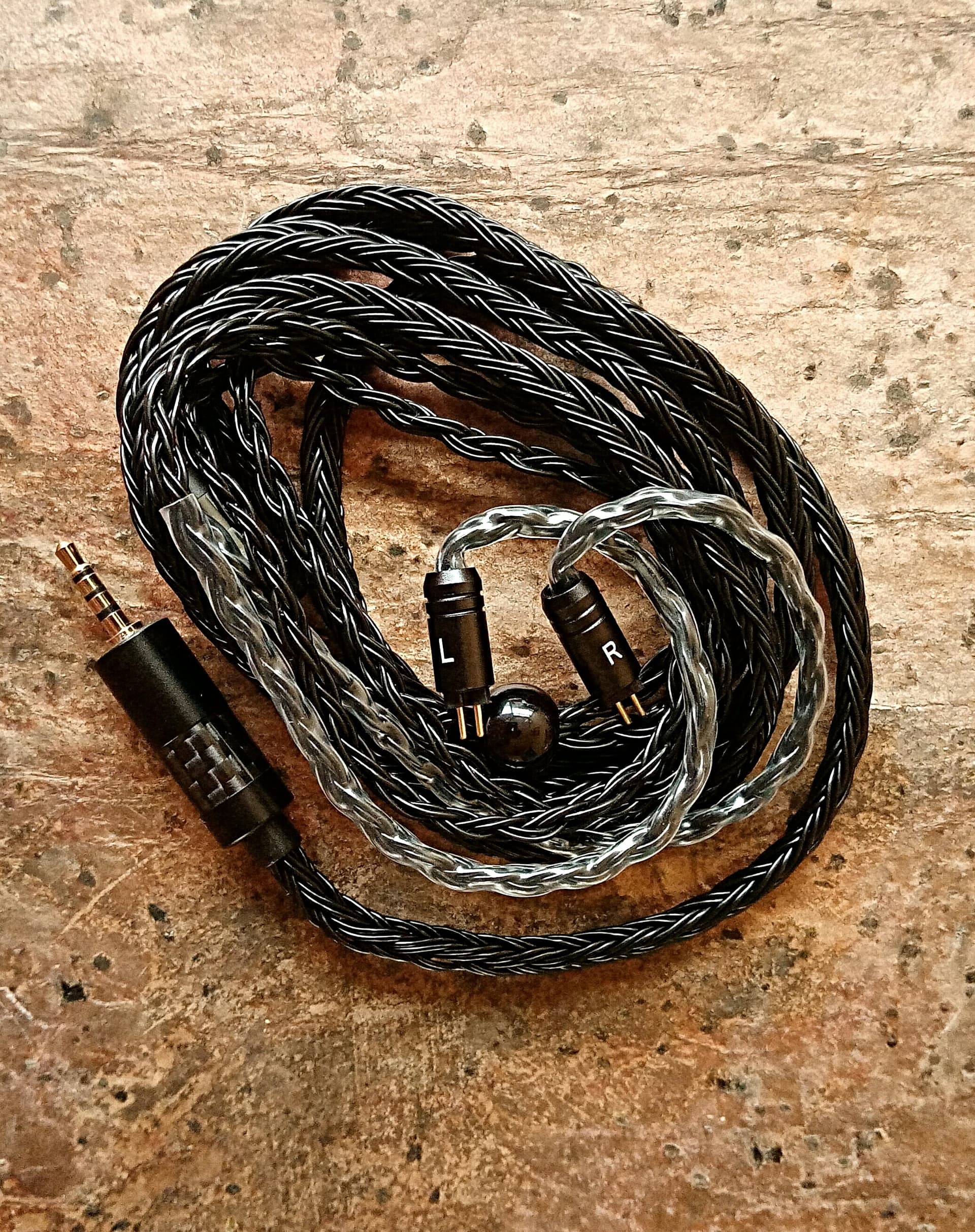
The Fedai 16 core cable comes simply packaged in a small envelope.
The cable is silver plated OFC (Oxygen Free Copper) but the purity is not specified. The sheath is black plastic and the closely-braided cable is very slim for a 16 core and therefore light and supple. It has a straight plug with a carbon fibre patterning and a similar design on the metal Y-split and there is a black spherical chin slider. The 2-pin plugs are plain black metal with channel identification in a plain white font. The clear plastic ear guides are fairly tightly curved but are comfortable.
The cable was tested with a variety of IEMs in the $20 to $50 price range and although this meant that the cable in some cases was more expensive than the earphones, the improvement in sound justified this approach. Copper cables are considered to produce a warmer tonality whereas silver-plated or pure silver cables tend to increase the brightness.
The first IEM I tested was the new Geek Wold GK10. It has a well-balanced sound but I found that the treble region was a little subdued using the stock cable (which is of good quality). The Fedai cable managed to bring out a bit more sparkle and life into the high frequencies. Piezo drivers do need a lot of power and I used a Hifi Walker H2 DAP as the source. The change of cable also produced a bit more impact and improved the soundstage.
The CCA CSN also benefited from the change of cable. The CSN is a very good performer at its price and has a more mature tuning than many of its competitors. Its stock cable is fairly basic and typical of CCA/KZ designs. Using the Fedai cable improved the transient response and attack and brought an extra feeling of space and excitement to proceedings compared to the stock cable. It revealed the true potential of the CSN and was probably the most successful of the three tested here.
The HZ Sound Heart Mirror is another remarkable IEM with a performance well above that expected for the price. It has a neutral/bright profile with copious detail and transparency. The stock cable is of high quality. In this instance, the change to the Fedai cable was not so successful. The Heart Mirror’s already bright tonality was enhanced and became sharper. There was a minor improvement in the tightness of the bass, and a slight expansion of the staging but there was a touch of extra brightness in the treble which unbalanced the overall profile.
The Fedai cable brought improvements in earphones which benefited from an increase in treble resolution and also helped to improve separation and detail, and for these it can be thoroughly recommended. However, I would not recommend the Fedai cable if you have a bright IEM, as the balance will be affected as described above.
I’m soon getting short adapters for my headphones (DHC triple threat). I have two cables that I use regularly. One with mini-XLR (ZMF) and one with lemo connectors (Focal).
My question is which connection is sturdier and can handle more connects/disconnects?
Thanks in advance!
I don’t know about sturdiness or durability in terms of connects/disconnects. But maybe consider weight and size as well? Which of the two are smaller and/or weigh less?
Also, the mini-XLRs seem easier to source and from looking at the DHC site, would cost less if you were to get additional adapters in the future - anything with the LEMO input on the bottom side is an additional $60.
Question: I just bought Focal Utopias (love them) and decided to see what the hubbub was about Silver Dragon cables. Just received them and some quick impressions before my question:
I hear some extra detail (not night-and-day, but for real), and a little extra in the bass, as compared with the stock cables.
The negatives for me (aside from the obscene price) are the feel of them. I don’t love the plastic-like casing and the very, very thin cables leading to each ear.
For those of you with more experience with cables than me - can I expect comparable positives with comparable, silver-wire cables from the third-party vendors discussed here (I have great experience with Arctic Cables, for example)? Put another way, is there anything that you find that’s unique/particular to the Silver Dragons that makes it worth putting up with the aesthetic/feel problems I have?
Thanks for any help, free advice, etc.
With the exception of obviously faulty cables that negatively impact sound, I found that the most important thing about a cable is it’s ergonomics and comfort. Any perceived changes in sound are usually so small as to not justify the expense. I also particularly hate the dragon cables because they are not ergonomic or comfortable. I think they are pain in the ass.
Let me ask a different, additional question - does anyone have a particular recommendation for a cable to pair with my Utopias? (I don’t think I’ll last with these Silver Dragons.)
What’s your budget? Cables get pricy real quick.
No kidding! I think I have to draw the line at $1,000, and I’m only going that high because I’m gonna need a 15-ft cable for optimal enjoyment where I listen.
I think it’s a jump to silver that’s going to make this an expensive proposition, so I’m wondering if silver is actually the best pairing with the Utopias and, if so, then looking for a particular recommendation for a maker.
I’m getting sufficient bass from these silver dragons with the Utopias and I value detail over slam, if that helps.
So: silver or no? And what brand?
Thanks!
Silver = brighter to my ears.
Utopia = too bright already to ears.
You like Arctic?
I do - any particular Arctic brand you’d recommend for this pairing?
IMO and experience the brand or model won’t make much difference beyond the copper vs. silver wire. Pick something that’s comfortable or affordable.
Understood - thanks. And I’m not looking to spend more than I need to; I’m just trying to do justice to the investment in the Utopias. I’m happy to spend for a basic Arctic Ion cable, but wondering if a little more money moving up their ladder will pay dividends.
They offer terminations for the Utopia.
I just got the Danacable Lazuli Ref for mine and am enjoying it so far. I found it helped with the bass and added some organicness/sweetness to the Utopias while keeping its technicalities. The Lazuli Ref Plus is supposed to bring out more of the treble sparkle if that’s what you’re looking for. They have a 30-day return (minus shipping and fees) if you are unsatisfied but I really like it paired with the Utopia (plus I got a discount). But it looks like it might not be the sound you are after. I’ve heard good things about the DHC Prion4 (haven’t tried personally) for detail but it looks to be out of your price range. I will note that the Danacable is thicc and not the easiest to handle. Anyway, just my 2 cents. You’ll probably be advised to find one that is ergonomically sound and to that I say, they’re right. But once I heard the Danacable myself, I think I’ll put up with it.
Audio Sensibility cables could probably get you into silver for your budget.
https://audiosensibility.com/blog/
Another consideration is to build a ten - twelve foot headphone extension cable, and a new cable for your Utopias. The extension cable could be used with other headphone cables. I had 4-pin XLR (6 meter) and single ended (4.5m) headphone cables reterminated /fabricated by Cardas Audio (Cross headphone 4x24 cable).
I’ve been replacing some of my aging RCA interconnects with Worlds Best Cables products. In searching for suitable models I came across their product comparison in Amazon comments. I already have some WBC items installed, and wish I’d seen this before buying them.
WBC’s answer is useful, but leads to additional questions. How “warm” and “bright” can these cables be? See bullets 1.0 and 2.1.1 to 2.2.3. Are tone shifts audible with short headphone system lengths (e.g., 1’ to 2’), or only with longer cable runs?
One of my setups sometimes has a DAC, a passive RCA switch box, a Loki, and a headphone amp used as a pre-amp in the chain – I think three or four warm cables in series might be a problem. WBC states Mogami 2549 offers the best combined performance (i.e., tone and noise cancellation). Any real world experience or comparisons?
Note: I removed the username and hyperlinks from the block quote.
Question: When deciding between gotham, mogami, and canare cables, where can we go to see the difference? How about the connectors?
Answer:
Hello [USER], though there is no single place where it explains the difference between each cable, please go through the below brief explanation.
1.0 Regular RCA Cables (low capacitance neutral & bright tones)
1.1 Standard everyday use
1.1.1 Mogami 2964: the general all purpose RCA cable from Mogami
1.2 Audiophile use
1.2.1 Mogami 2497: Audiophile grade RCA cable
1.2.2 Mogami 2803: do not allow the looks fool you. This is unarguably the most high definition RCA cable and definitely the most expensive2.0 Directional RCA Cables (enhanced EMI/RFI rejection capabilities to be used in highly noisy environments)
2.1 2-core RCA cables
2.1.1 Mogami 2549 (low capacitance and directional, the best of both worlds, bright tone and improved noise cancellation)
2.2 4-core RCA cables
2.2.1 Mogami 2534 (slightly low capacitance, warm tone and improved noise cancellation)
2.2.2 Canare L-4E6S (medium capacitance, warmer tone and better noise cancellation)
2.2.3 Gotham GAC-4/1 (the most capacitive of all our RCA offerings, the warmest tone, but offers the best noise cancellation of them all)As for the RCA plugs;
Amphenol ACPL : Smallest in size and the least expensive
Amphenol ACPR : Medium in size and slightly expensive
Eminence Locking RCA : Biggest and the most expensive and gives a customizable fit thanks to the locking featureAll of the plugs feature gold plating, so the conductivity is pretty much the same
We sincerely hope the above information will be useful to you.
Warm regards,
WBC
By WORLDS BEST CABLES [SELLER ] on December 17, 2020
I’d be surprised if many of us that choose to use WBC level of cables believe there is signifigant or any difference in the way well engineered RCAs sound. It would seem if you beleive i using cables as EQ you would buy more expensive cables.