Cool stuff @Resolve. How close are you to publicly releasing the headphones.com version of squig link?
1 Like
I’m not exactly sure when the database will be open to the public, but there has been some beta testing from folks who have rigs.
1 Like
Is there an update to this?
Also , I think it would be super helpful to offer Compression measurements as well in IEMs to see how well the drivers work under stress?
How about time domain plots, like a waterfall or spectrogram ? Or are those redundant because there aren’t really any reflections?
Perennially, the update is “we’re working on it”
Compression/gain linearity is something I’d very much like to add to our tests, but we’re currently working on other more pressing stuff. Expect it someday™
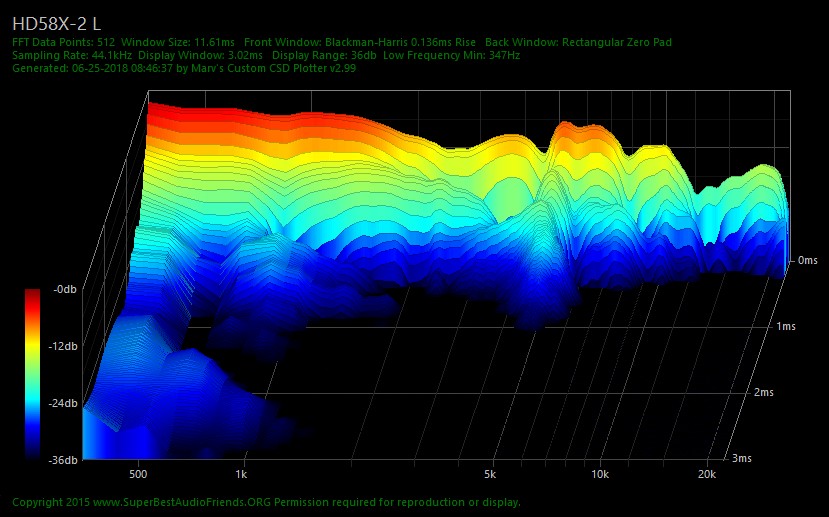
Headphones are, until proven otherwise, minimum phase devices. We do look at excess phase response in headphones, but absent large excess phase, they are min phase. If they are min phase, we gain no information from waterfall plots that is not present in a single FFT of the same length.
2 Likes
So something like this ( taken from SBAF) is useless or ‘ misleading?
Isn’t that useful in headphones to see excess ringing in certain freq?
Also how about impulse response measurements as well?
Thanks so much for the response ! ( no pun intended )

Yes
No, unless something is broken.
These other views don’t indicate something distinct from FR in minimum phase devices, which is what headphones are. So the ‘ringing’ there is proportional to the corresponding FR features. Change those features with EQ and the time domain information changes with it.
This is something I initially got wrong as well so I understand the assumption, but at this point I’m more curious where folks are still getting these ideas from - mainly I wonder if these ideas propagate because that’s what it looks like or if there are still sources of misinformation actively contributing to the confusion on this.
1 Like
Could you be referring to this?
The Hidden Dangers of Headphones: Shocking Conspiracies Unveiled
- “Frequency Hypnosis Syndrome”
Headphones emit alpha-wave-mimicking frequencies that align with brainwave patterns, subtly influencing mood and decision-making. Coincidence that you bought that overpriced coffee after wearing them? Think again.
- “Cranial Resonance Interference”
Modern headphones, especially noise-canceling ones, allegedly disrupt the brain’s natural resonant frequency, causing migraines, memory loss, and an inability to distinguish bad music from good music.
- “Harmonic Tinnitus Harassment”
Persistent ringing in your ears after using headphones isn’t harmless tinnitus—it’s a signal. Certain frequencies resonate with the Schumann Resonance (Earth’s “heartbeat”), detuning your biological rhythm and leaving you open to mind control.
- “Bluetooth Mind Manipulation”
Bluetooth devices utilize quantum waveform inversion technology (whatever that means) to sync with your inner thoughts, embedding subliminal messages in your favorite songs.
- “Sonic Brain Fry”
Extended use of headphones at high volume allegedly generates microwaves from the diaphragm’s electromagnetostatics, slowly cooking your gray matter while you jam to 80s classics.
- “The Treble Conspiracy”
Manufacturers have secretly boosted treble frequencies to trigger cochlear burnout, forcing you to buy more expensive hearing aids—conveniently produced by the same companies.
- “The 440 Hz Lie”
Modern headphones are tuned to the unnatural standard of A=440 Hz, which some conspiracy theorists claim was imposed by shadowy elites to destabilize the human spirit. Properly tuned headphones at A=432 Hz could awaken your chakras—but the industry won’t let that happen.
- “Dynamic Driver Deception”
The so-called “high fidelity” dynamic drivers in headphones emit low-level infra-ultrasonic pulses that interact with chemtrails. Together, they create a feedback loop that amplifies global warming.
Are your headphones just speakers—or the key to humanity’s downfall? Wake up and listen responsibly.
Brought to you by the Weekly World News:
Thanks man.
That was very to the point and concise.
How about Impulse response for IEMs?.
I think Tyll did some of this with the limited IEMs he reviewed.
Would those be helpful in seeing attack and decay of how the drivers work and be useful?
Thanks again. Sorry for all the question, but you guys stimulate this hobby so….lol
I wonder if you hit up any universities that have acoustics as a major could help. I’m pretty sure Hartford and MIT have acoustics labs and knowledge.
1 Like
Penn State did when I went there in the mid 70s. A friend was a grad student in engineering acoustics. In fact I bought his modified Rectilinear III speakers and still use them.
1 Like
Attack and decay in the audiophile sense are subjective terms that refer to particular aspects of the experience. We often use these terms to describe what we’re hearing, but those experiences likely are not conferred by separate acoustic properties from frequency response at the eardrum. I say likely because… we don’t know how these products actually measure at the eardrums of individuals.
There have been some cases where certain in-ear headphone products are not minimum phase, if memory serves. But impulse response in most cases should probably be thought of as a more primitive ‘low res’ view of FR.
1 Like
Not necessarily disagreein with the above. But headphones can most definitely ring, just like any transducer. The ear has its own resonant effects and characteristics that will also show up on a raw FR plot, measured inside the ear at the DRP or eardrum reference point. So separating the “good” and “bad” resonances or ringing on a headphone plot can sometimes be a little challenging.
EQ is also generally better for correcting broader band tonal imbalances than for correcting narrow band or “high Q” resonant peaks or cancellation effects. Something that might also be worth considering.
CSD or waterfall plots might also be useful in confirming that EQ has been successful in completely eliminating narrow band resonances or ringing… if the headphones can be measured with the EQ filters applied.
What about smearing, trailing ends of tones, and such?
Yeah, also subjective descriptions of the sound. The effect is real, but it’s a subjective/psychoacoustic thing that also won’t track similarly for everyone.
3 Likes
Resolve,
It would be great to see a discussion , video or something about the different types of drivers in IEMs if possible.
I have no idea of the quality of the drivers different companies use.
And what their properties are.
Do more expensive IEMs have better drivers? Like in speakers or headphones. There are good , bad and ok drivers , with different technical abilities.
Distortion, linearity etc.
I know big brands like Sennheiser make their own drivers for IEMs.
But how about the rest?
Does Moondrop use different drivers than Dunu as an example?
Maybe that would also help people choose IEMs
Cheers.
2 Likes
I like that idea. ZMF uses some interesting materials, I’d like to know more about the organic material. What are the trade offs between weight and stiffness, what are the cost considerations and difficulty in manufacturing?
It seems like there is more to consider with dynamic drivers. E-stats seem to just go for low mass. Not so sure about planars.
1 Like
Thanks
Well the IEM market is crazy as far as saturation and how many new flavors of IEMs get made per month.
And it’s dominated by the Chinese market. So I’d like to know what we are getting. More so as another gauge of how good a specific IEM is.
I desing my own crossovers for my speakers. So I know it’s a sum of its parts. And the BOM is never representative of the work that went in etc.
but it’s still a variable and I think it would be good to know if someone is using a cheap ‘ bad’ performing driver or something good.
Cheers
We’re getting higher prices is what.
Maybe sourcing would be a useful topic for those of us in the US. Assuming big tariff increases in Chi-Fi, what are the other companies and places we should look for. And if we create market barriers here, will Chi-Fi get dumped in the rest of the world, or will they need to cut back unit numbers and lose economies of scale?
I’m not sure that it’ll have a meaningful impact on audio gear. The low end market is so cheap that doubling the costs by tariffs wouldn’t matter, and the high end involves lots of markup per US labor and luxury pricing. Does the $8K Susvara go to $16K or does the vendor eat the margin?
1 Like
Not necessarily, though some designs end up being more complicated, and then consequently end up being more expensive.
As far as ‘technical capabilities’, I’m doing a video on that. That actually has nothing to do with driver quality beyond just like… not broken. But with that said, low distortion, linearity, low modality, that sort of stuff is all desirable in drivers from a headphone design perspective.
That does not make the products the ‘good’ ones are found in sound more ‘technical’, as you can put the best performing drivers in the world along these dimensions in poorly conceived products and have the end result sound super undetailed, untechnical… blunted and so on. Similarly you can have way worse performing drivers in well-conceived products end up sounding extremely technical. You can also have poor performing drivers in poorly conceived products and SOMEONE might find it to sound ‘technical’. Herein lies the challenge of high end audio.
But if I were designing a headphone there are certain characteristics of a driver that I would look for. And by and large I think headphone engineers do the same thing, they just may all have differing ideas of what ‘good’ is there.