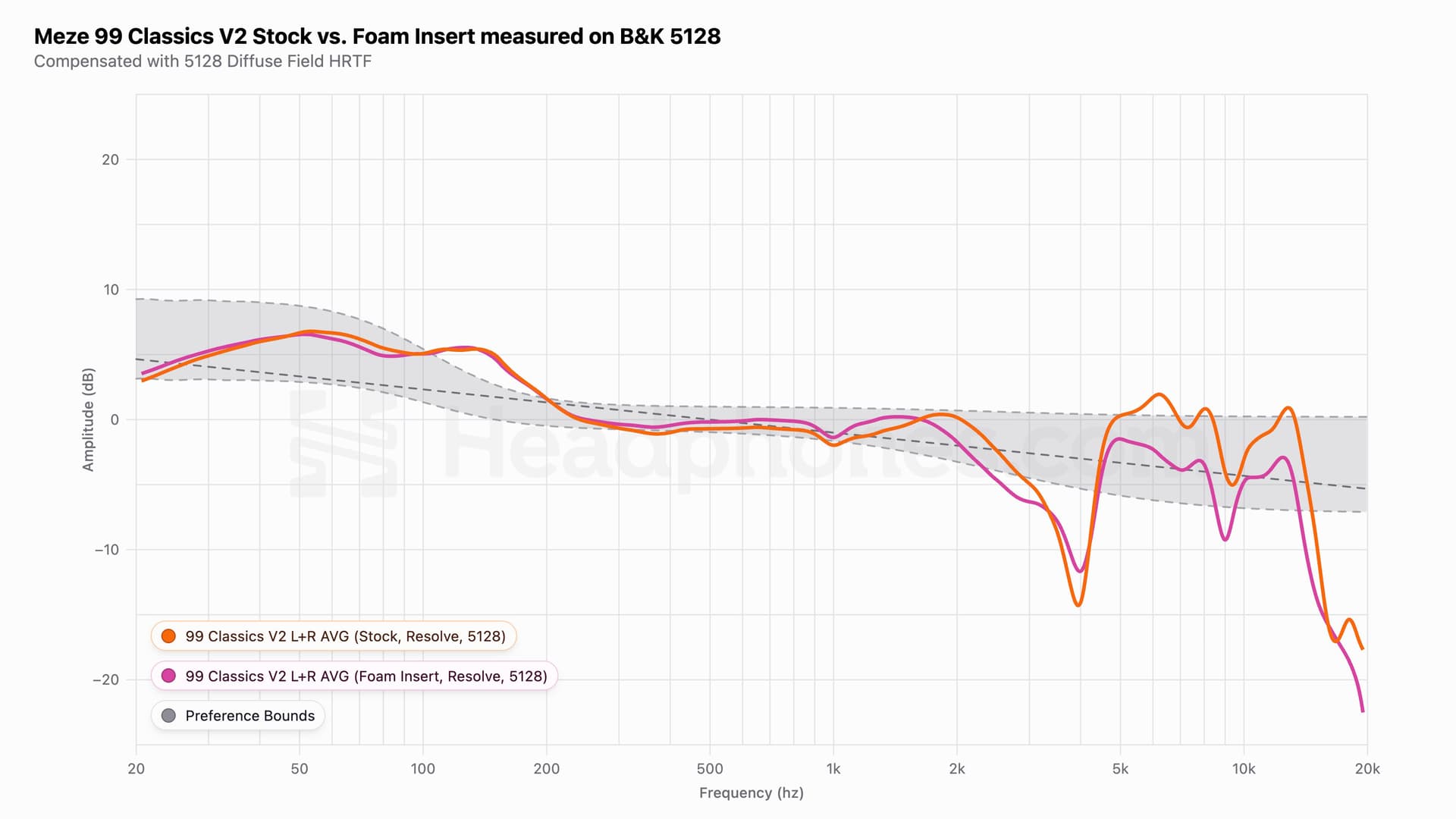
Ordinarily we post these results from multiple fixtures to effectively simulate frequency response behavior across different heads and ears, using both GRAS and B&K systems. In this instance, however, we’re focusing exclusively on the 4.3 based B&K 5128 since the 99 Classics V2 is a closed-back headphone, which is going to be sensitive to the ear impedance. This means that for an accurate prediction of its sound, particularly in the bass, we want to focus on a measurement fixture that accounts for this sensitivity.
For clarification, this does not mean the pinna effects specifically are going to be more accurate, or that this is a better indication of “the average human”, just that the system is more humanlike. Treble features, particularly above 3khz will still vary substantially from person to person.
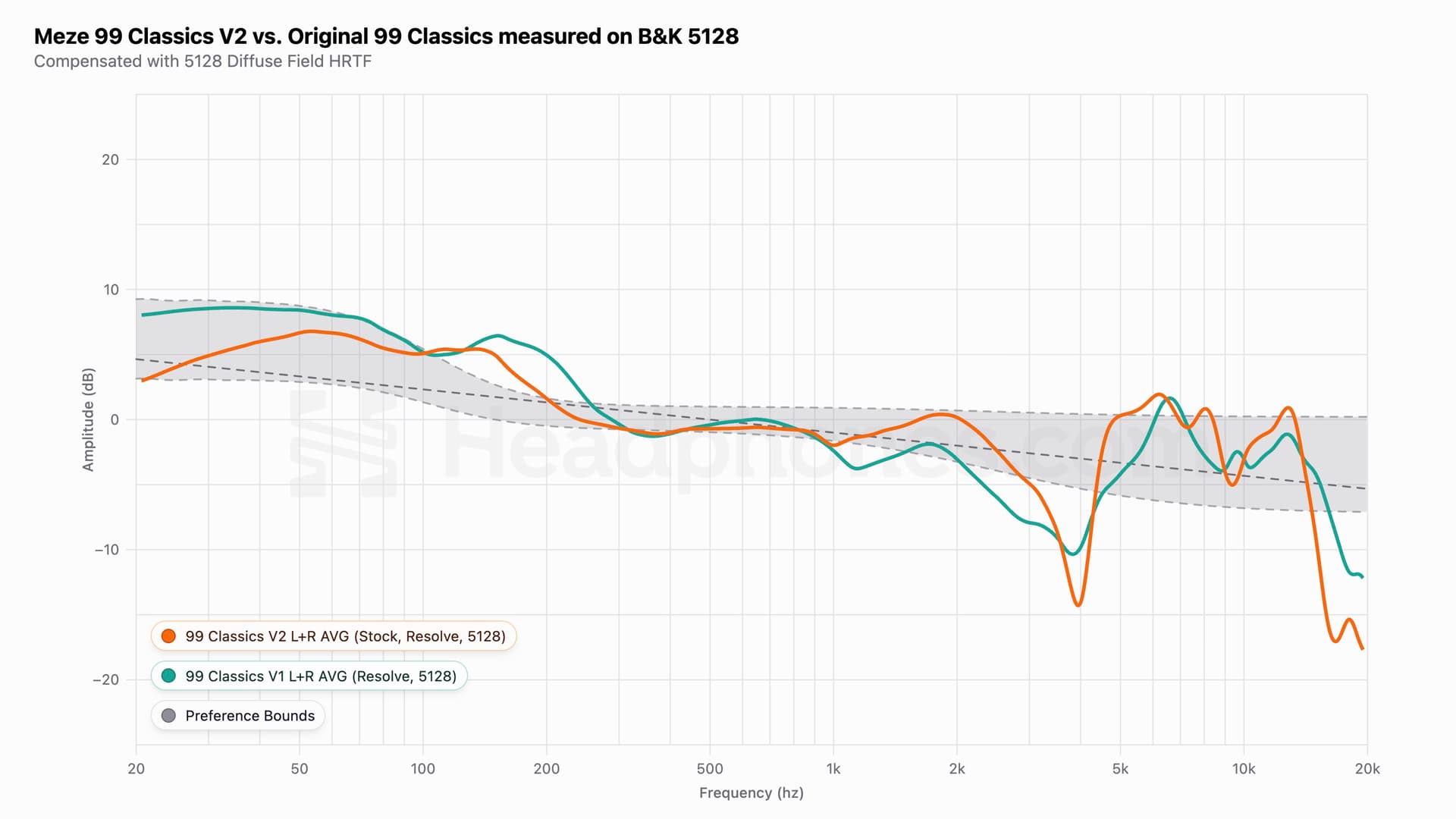
Meze 99 Classics V2 Frequency Response Raw (Channel Matching)
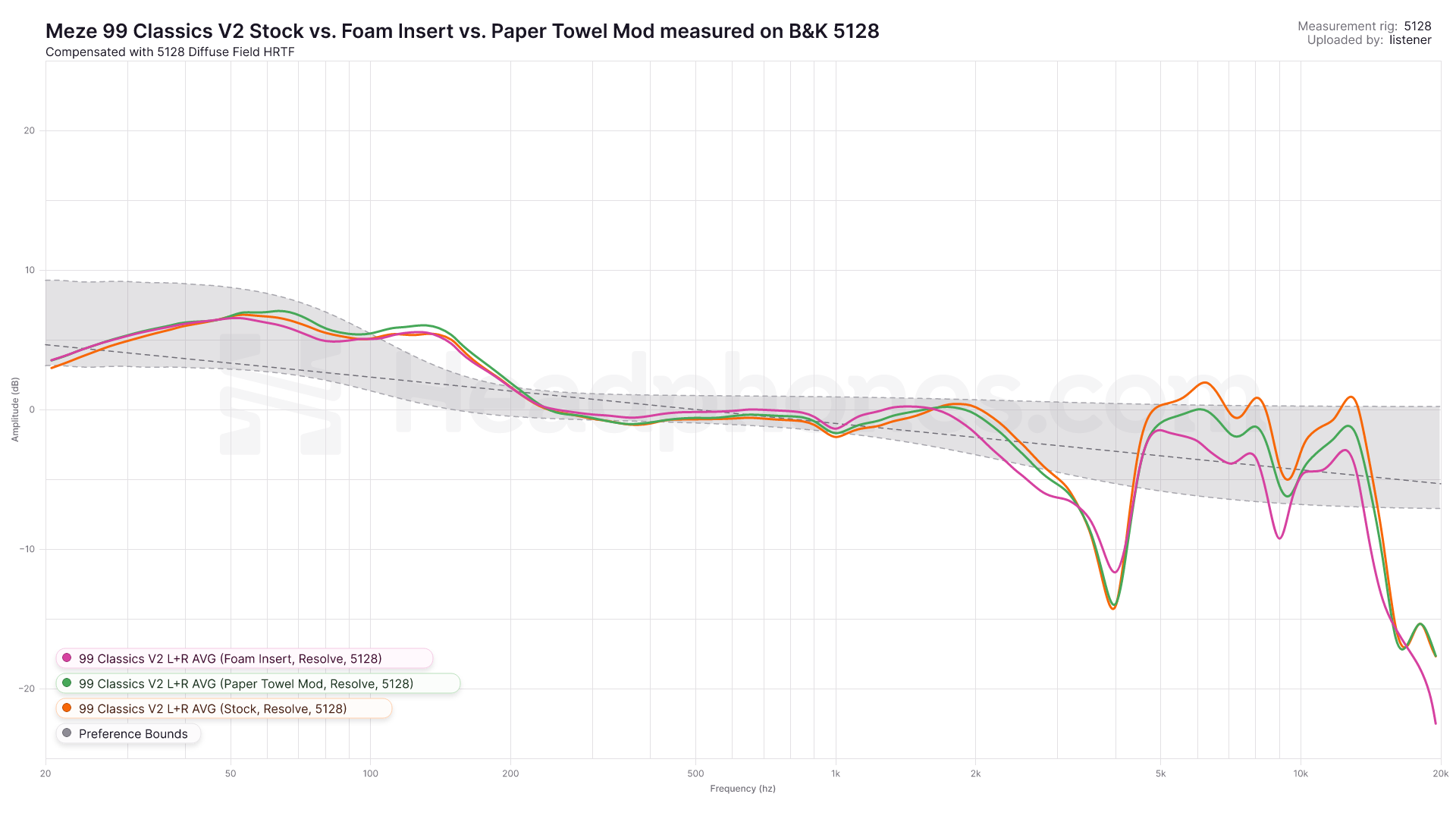
I was also able to do some alternative damping using paper towel instead of the foam inserts provided by Meze, since I wanted a sound signature that was slightly in between these two sound profiles. Here’s what that did:
Comfort is great once you bend the headband to accommodate the appropriate coupling angle
Pads are wider than the original but not necessarily providing more space inside the pad for the ear
Pad mounting system uses clips rather than the pad lip system on the original
Sound is a slightly v-shaped take on neutral, tipping slightly towards treble without the foam inserts, and then goes to a warm/relaxed sound profile with the foam inserts. I like it in between with the paper towel mod. Bass and mids are exceptional though by default I find it a bit spicy in the mid treble due to its slight emphasis to that region. I EQ down 7.2khz by about 3dB with a Q of 4.
Intangibles with this one are very good, way better than the original 99 Classics when comparing back and forth. It’s more intimate for its presentation - so not about the spaciousness effect - but it does very well for detail, timbre, and sense of impact down low. The slight forwardness to the mids around 2khz pairs with that slight bass enhancement is a great combination for some tasteful flare.
Sennheiser HDB 630 have much better sound quality (I have only some hour with Meze but it is so big difference) and have transparency mode, ANC and parametric EQ.
Just another level and not too much more expensive.
It’s a common feature on various closed-back headphones. Sometimes this kind of thing can be a deep phase cancellation issue, though I’m not entirely sure its cause here. All I can confirm at the moment is that there is an audible dip there.
Do you mind please sharing the EQ you mentioned in the video?
Also in the video you said that you subtly change the angle by which the earcups taper in to your ears. Did you do that by bending the metal headband or some other way?
All I can confirm at the moment is that there is an audible dip there.
What feature does this Dip provides ?
Looks like they wanted to make the positioning of instrument sort of stuff fancier - without loosing much of the 1-2Khz region.
I don’t think it’s intentional. I think this is just a compromise they were willing to accept to achieve acoustic engineering goals. Someone brought up recently that you also see this kind of dip feature on a lot of other headphones, even open back designs, and it’s true. Even super high end headphones have this commonly. Personally, I’m not bothered by it, since I EQ, but I’d also prefer it to not be there.
A dip in the 3 kHz to 5kHz range has been common for a long time. I think it’s because that is a very sensitive (and therefore fatigue-inducing) range for the human ear. I think (probably related) it’s around the resonant frequency for most human ear canals.
A couple examples from a long time ago, both from Stereophile measurements:
Fig.3 Stirling Broadcast LS3/5a V2, anechoic response on drive-unit axis at 50", averaged across 30° horizontal window and corrected for microphone response (red trace), with the similarly derived responses of a 1996 KEF LS3/5a sample (blue, offset by –5dB) and a 1978 Rogers LS3/5a sample (green, offset by –10dB).
Fig.7 Quad ESL-63, anechoic response on tweeter axis at 1m.
The LS3/5a variants and the Quad ESL-63 are pretty well-known as speakers that get the midrange right (whatever their other faults may be), and they all have a dip in that region.
I see the logic in @Resolve’s desire to EQ from flat, but I think I’d rather EQ from perceptually natural (and objectively not flat) than objectively flat (and perceptually bright). YMMV of course.
The 3khz band is primarily the effect of the ear canal, and since ear canal shapes and sizes can vary dramatically, there’s bound to be some sensitivity variation there too. 3-4khz is a bit above that, closer to where there’s more pinna contribution, but I agree this is a band that is going to have perceptual sensitivity variation. Still… I have to imagine that the engineers at Meze would’ve chosen to not have that dip had the rest of the acoustic design allowed for that. Like it’s the concession they had to make to achieve the good things they did elsewhere, and it’s a lesser of many tradeoffs. But that’s just pure speculation on my part.
Evolutionary analyses often focus on human screams (e.g., 2K to 3K Hz) as an underlying cause of non-linear human hearing sensitivity. Screams (and babies cries) communicate essential and urgent safety information to the social group, and have great value when hearable and identifiable. Too low of a frequency and an alarm call (scream) loses location information. Too high a frequency and it loses range/distance.
Just got mine in, the paper towel mod (in my case, blue shop towel) is the way to go, reins in the treble just a bit. Two layers is too much though, it cuts the treble more than the included foam and makes it sound muffled. I’ll be experimenting some more with other materials to see if I can dial in the treble just right without EQing.
Its my first closed back too, so the “ear muff” effect took a little getting used to coming from open-backs.
I’m new to the forum and interested in a comfortable headphone to wear at home for pure pleasure listening during long listening sessions. I don’t need a closed back but it would be future proof. I’m wondering if the 99 Classics V2 are worth it (more comfortable, higher resolution, isolating) over the Fiio FT1?
I suppose the V2 are still quite new so not many people have tried them.
Thanks for the push, I suppose if I don’t need closed backs then I should enjoy open backs for as long as I can.
I actually already plan on buying the HEDD D1’s as I record music and they seem like a great option, perhaps they will suffice as a ‘pure pleasure’ headphone too with a bit of EQ.
I just bought the Meze 99 Classic V2 headphones. The standard cables are made well and the sound quality is solid, but I’m wondering how much difference the Meze balance cables would make. Anyone have experience with balance cables on these headphones?





 and interested in a comfortable headphone to wear at home for pure pleasure listening during long listening sessions. I don’t need a closed back but it would be future proof. I’m wondering if the 99 Classics V2 are worth it (more comfortable, higher resolution, isolating) over the Fiio FT1?